logo

SUPPLY CHAIN PERFORMANCE MANAGEMENT

Every Product Has a Supply Chain

Every product or service reaches its user through a connected network of organizations, people, processes, technologies and resources. An effective supply chain coordinates these elements so that the right product, service or capability is available at the right place, at the right time, in the required condition and at an economically sustainable cost.

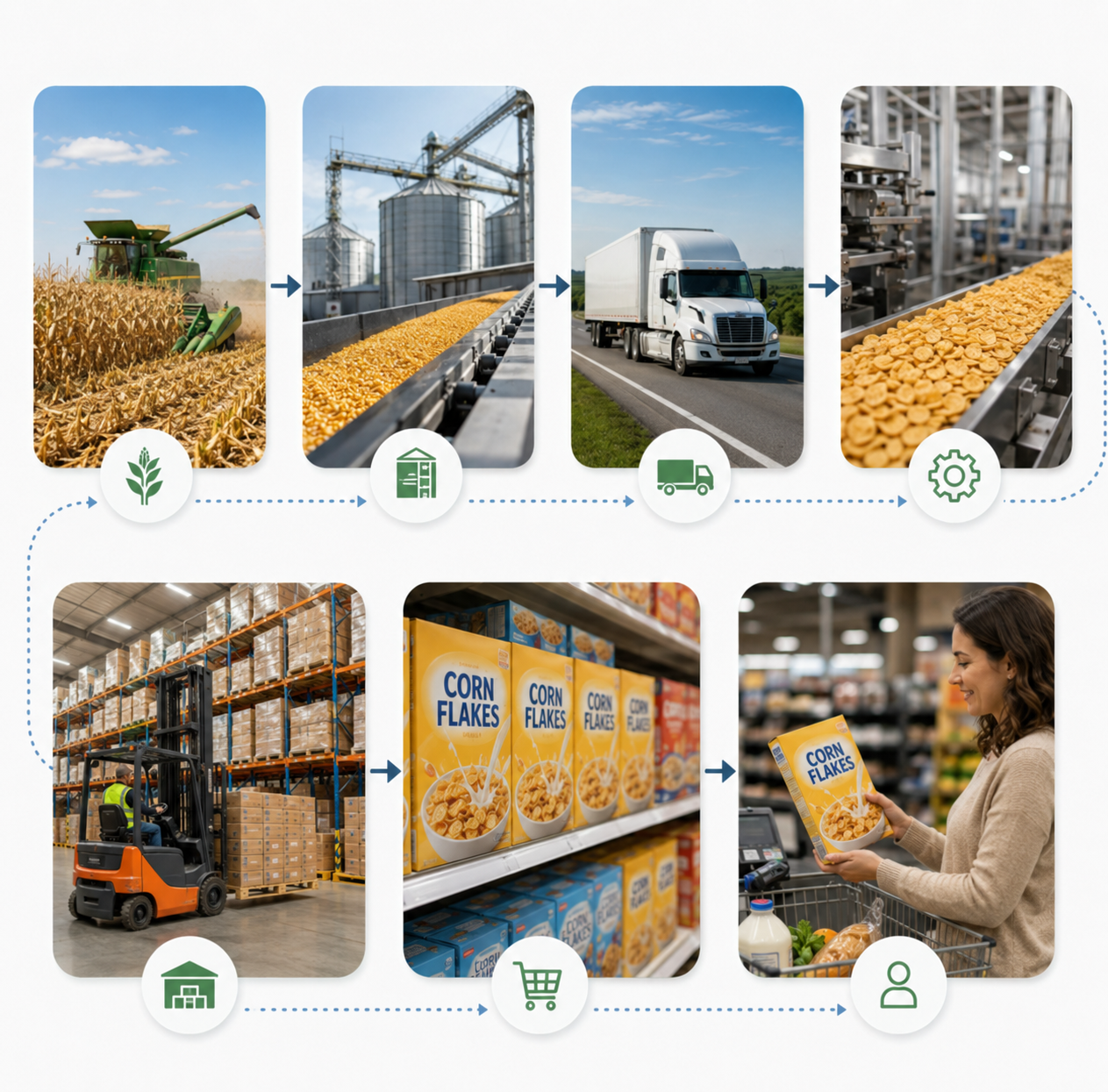
Consider a simple breakfast product such as a box of cornflakes. Its journey may begin with seed, farming inputs and harvested grain. The corn is then collected, stored, transported, processed, packaged, distributed to retailers and finally purchased by a consumer. Information, money, materials and decisions flow across every stage of that journey.

Complexity Grows with the Network

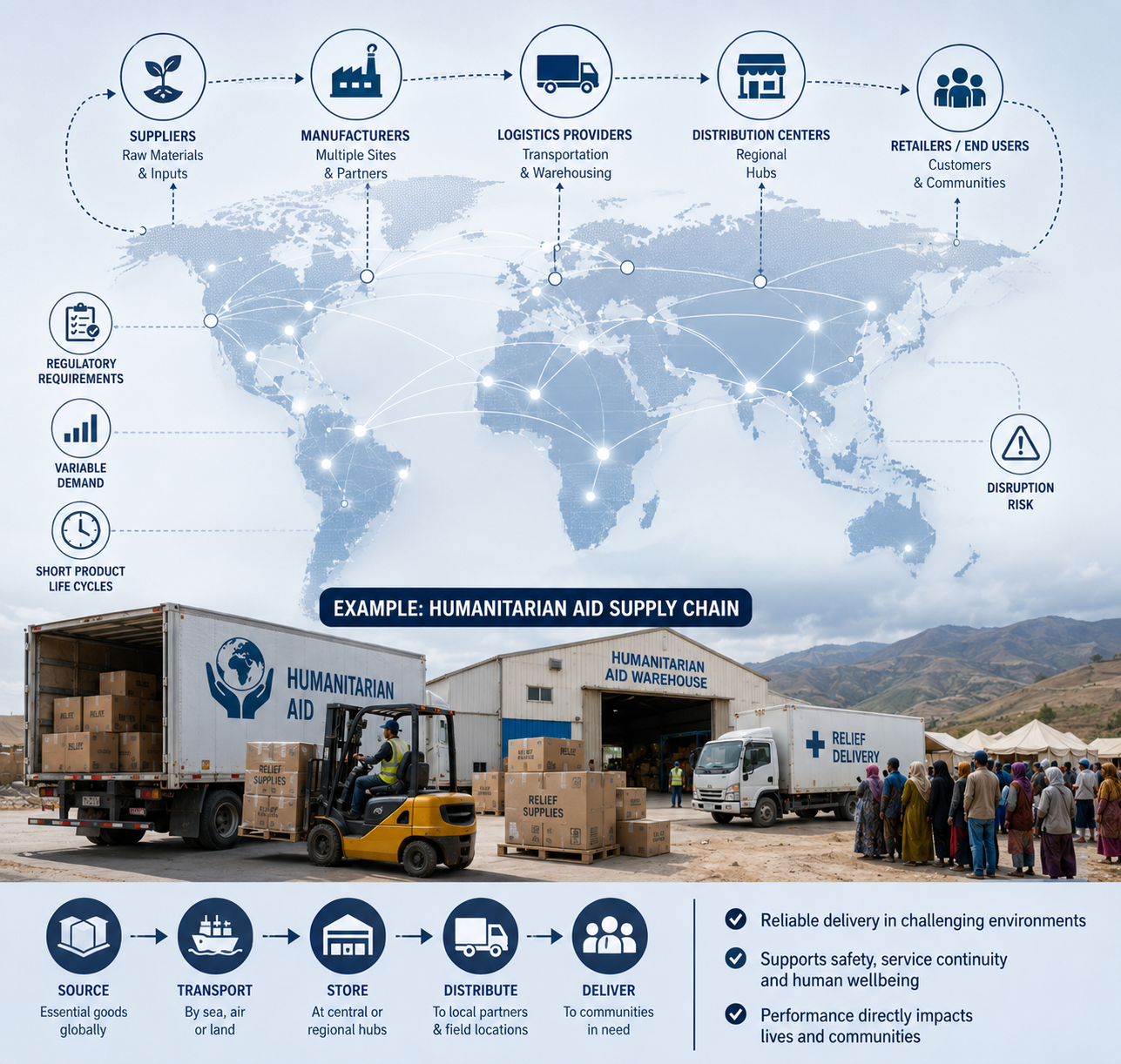
The longer and more interconnected a supply chain becomes, the more difficult it is to manage. Complexity may arise from thousands of stock-keeping units, global suppliers, multiple sites, regulatory requirements, variable demand, short product life cycles or the need to respond quickly to disruption.

A hospital, for example, must ensure the availability of medicines, medical devices, sterile consumables and critical spare parts. A humanitarian organization may need to source, transport and distribute schoolbooks, shelter materials or relief supplies across difficult operating environments. In both cases, poor supply chain performance can affect much more than cost; it can influence safety, service continuity and human wellbeing.

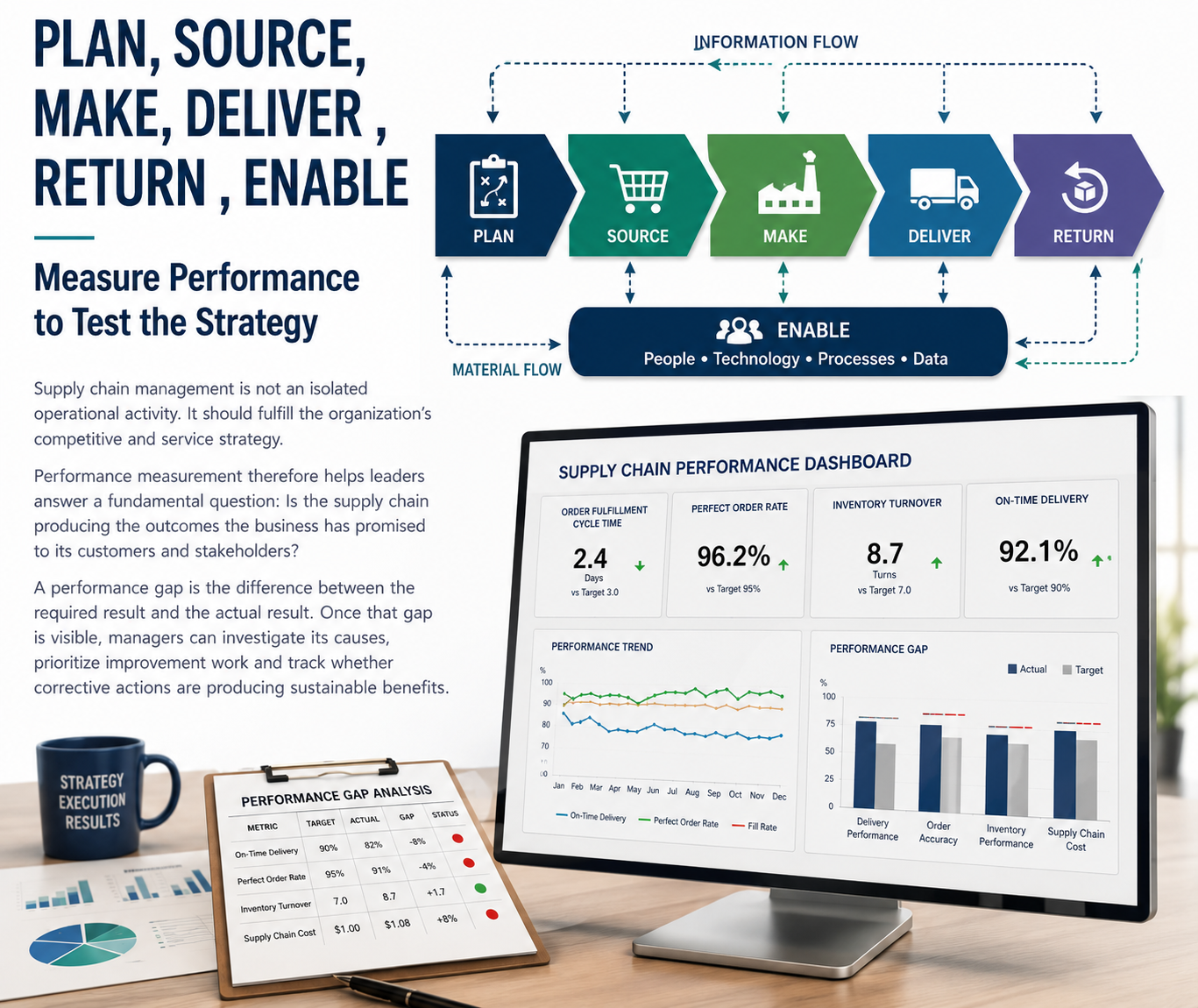
PLAN, SOURCE, MAKE, DELIVER , RETURN , ENABLE

PLAN, SOURCE, MAKE, DELIVER , RETURN , ENABLE

Measure Performance to Test the Strategy

Supply chain management is not an isolated operational activity. It should fulfil the organization’s competitive and service strategy. Performance measurement therefore helps leaders answer a fundamental question: Is the supply chain producing the outcomes the business has promised to its customers and stakeholders?

A performance gap is the difference between the required result and the actual result. Once that gap is visible, managers can investigate its causes, prioritize improvement work and track whether corrective actions are producing sustainable benefits.

Select KPIs from the Objective not from a List

A KPI should never be selected simply because data is available or because another company uses it. The appropriate measure depends on the strategic objective, the process being controlled and the decision the measure is intended to support.

For example, when a company competes through rapid time to market and responsive fulfilment, the supply chain may adopt an objective such as “increase delivery speed and responsiveness.” A relevant KPI is Order Fulfilment Cycle Time: the elapsed time from receipt of a customer order until the order is delivered to the customer.

Benchmarking: Learning from Relevant Performance

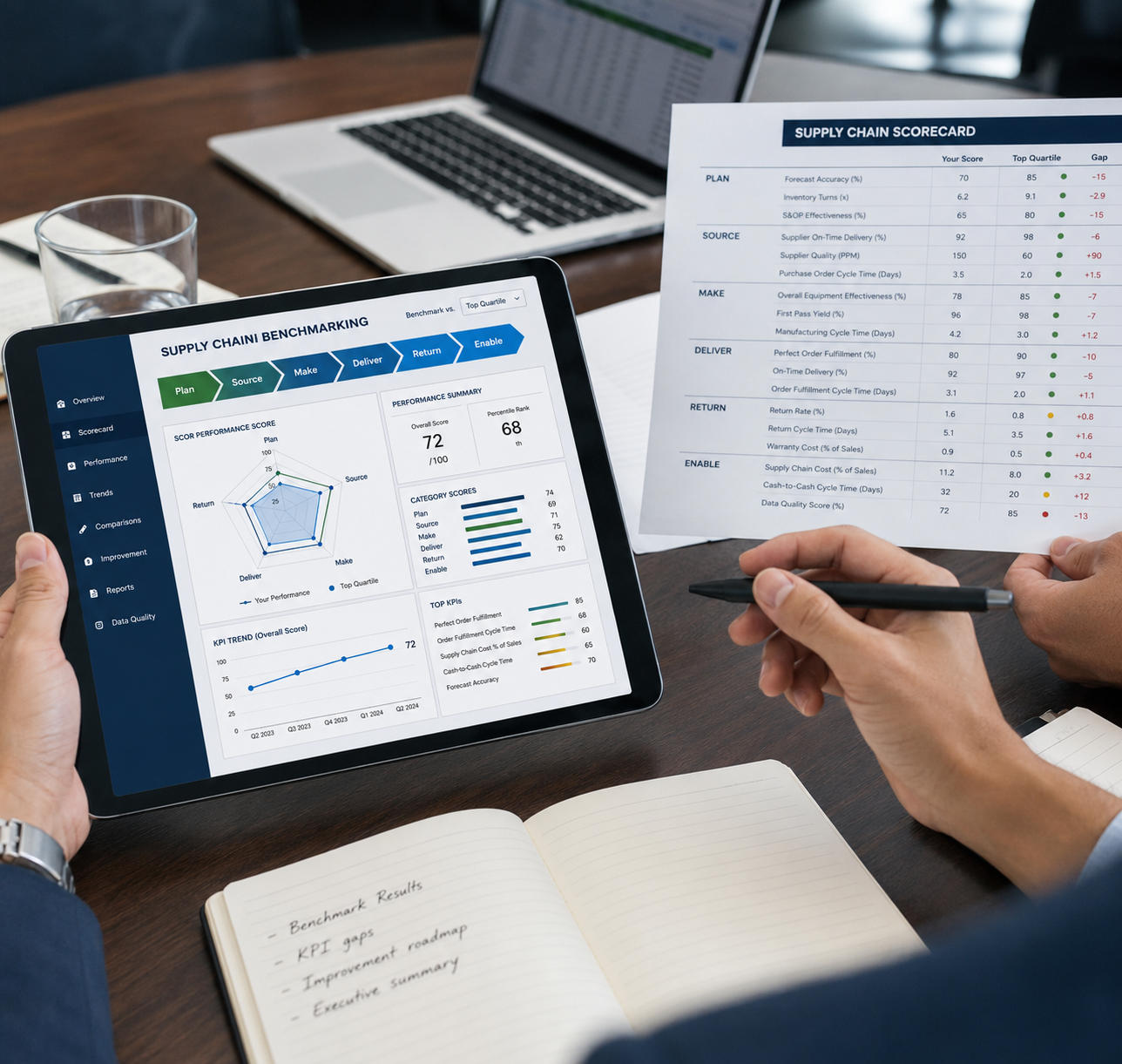
Benchmarking compares performance, process design or practices with an appropriate reference point. The purpose is not to copy another organization blindly. It is to understand the performance gap, identify practices that may explain superior results and decide what can be adapted to the organization’s own strategy, operating model and constraints.

Useful comparisons may be internal, competitive, functional or cross-industry. A strong benchmarking exercise uses consistent definitions, comparable scope and reliable data. It also looks beyond the number itself to understand the process, technology, skills and governance that produce the result.

How SCOR Supports Performance Improvement

The Supply Chain Operations Reference (SCOR) model provides a structured management framework for analysing and improving supply chains. It links processes with performance metrics, practices and people capabilities, helping organizations create a common language across functions and supply chain partners.

SCOR is especially useful because it encourages leaders to connect four questions: What process are we evaluating? What result should that process produce? How will performance be measured and benchmarked? What practices and skills are required to close the gap?

Principles to Remember

  • Select a reasonable number of objectives and KPIs. Too many measures dilute attention and accountability.
  • Data is your friend—but only when it is accurate, timely, visible and understood.
  • You cannot improve what you cannot define and measure consistently.
  • You get what you measure, so measure what truly matters to customers, strategy and long-term performance.
  • A KPI is a signal, not a solution. Improvement requires process analysis, collaboration, capability and disciplined execution.

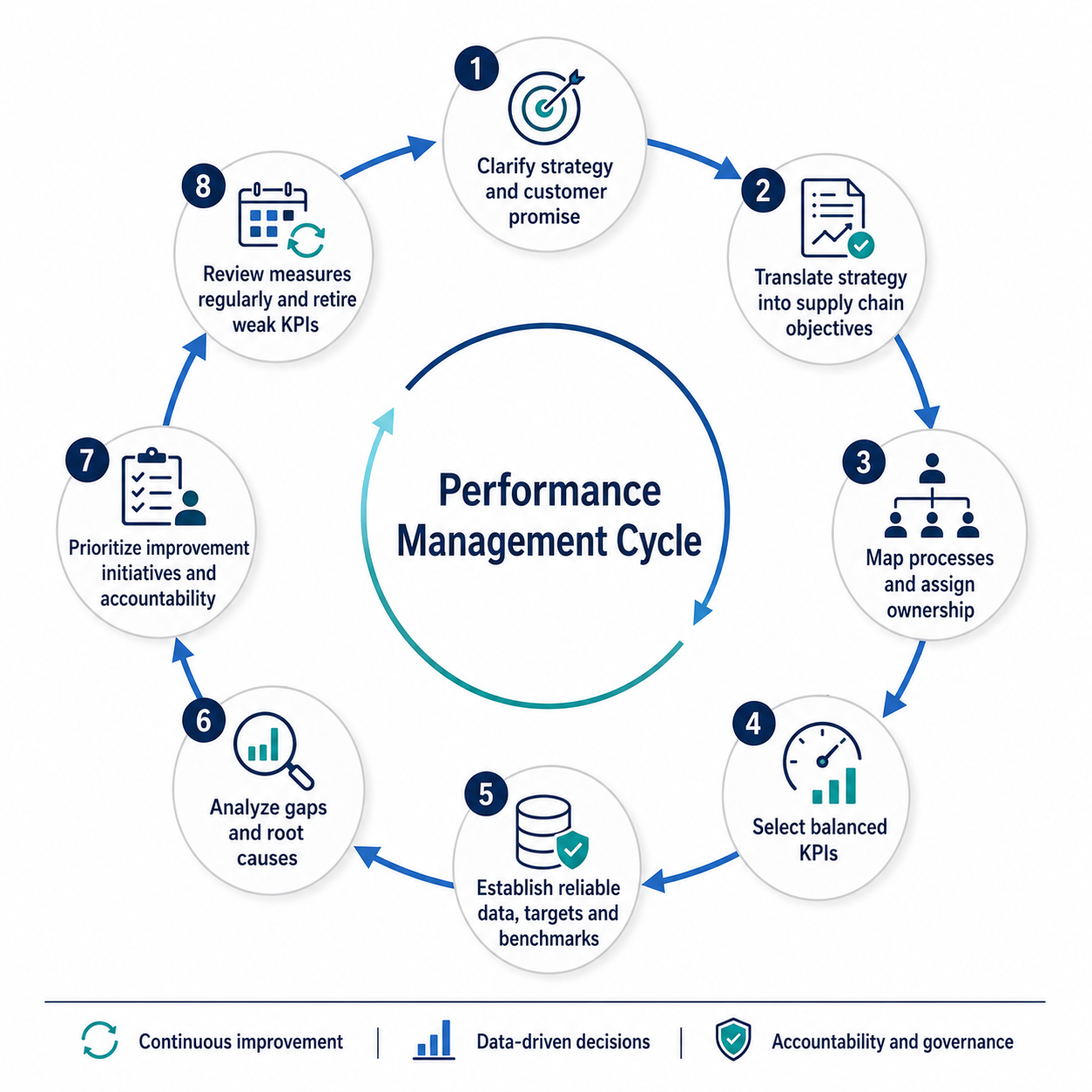
A Practical Performance-Management Cycle

  1. Clarify the business strategy and the customer promise.
  2. Translate the strategy into a small number of supply chain objectives.
  3. Map the processes that influence each objective and assign clear ownership.
  4. Select a balanced set of outcome and process KPIs using consistent definitions.
  5. Establish reliable data, targets and relevant benchmarks.
  6. Analyse gaps and root causes rather than reacting to isolated results.
  7. Prioritize improvement initiatives, assign accountability and monitor benefits.

Review the measures regularly and retire KPIs that no longer support decisions

Final thought

Effective supply chain performance management is not about building the largest dashboard. It is about creating a clear line of sight from strategy to process, from process to measure, and from measure to action.

References and Further Reading

ASCM. SCOR Digital Standard (SCOR DS): a framework used by supply chain professionals to analyse, evaluate and optimize supply chain processes. Check out ASCM SCOR DS Training – Muhakat to learn more about the SCOR model and the benefits of learning that to enhance  organization performance.

share this recipe:

Download Brochure

Full Name