logo

Supply Chain Maturity Assessment: Using SCOR DS to Build a Practical Transformation Roadmap

Supply chain transformation becomes difficult when an organization cannot clearly describe its current state. Leaders may know that delivery performance is weak, inventory is high, planning is inconsistent or costs are rising, but these symptoms do not always reveal the underlying capability gaps.

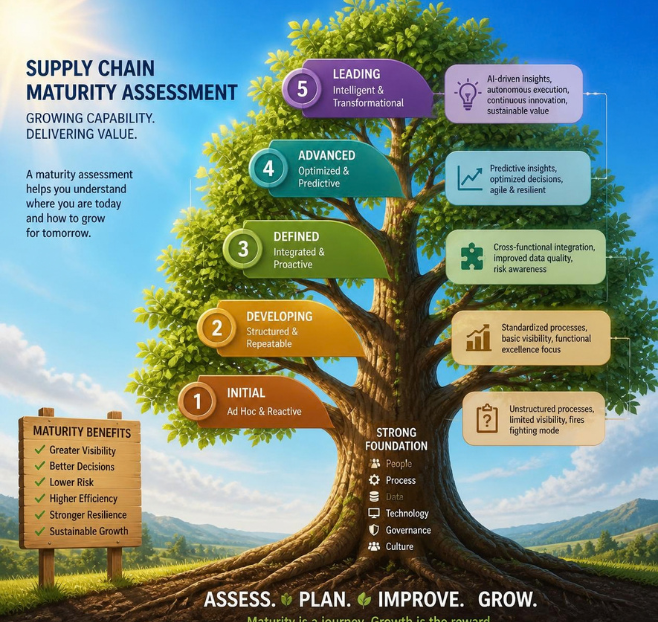
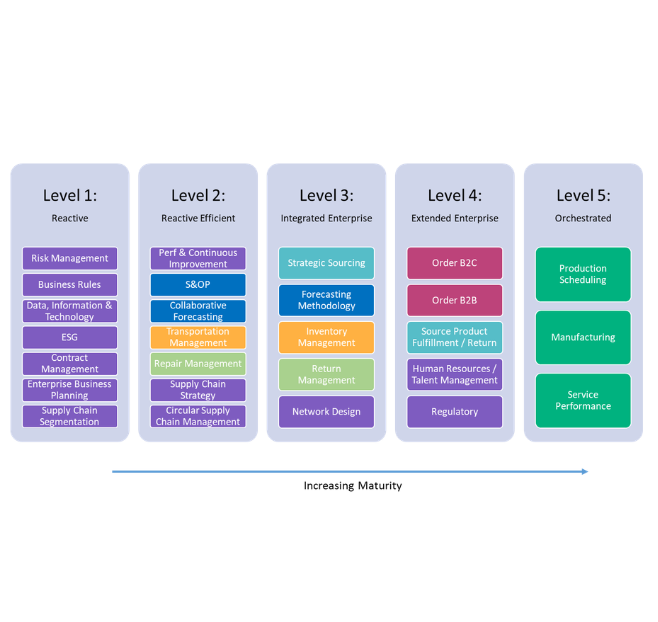
A maturity assessment creates a structured baseline. It helps organizations understand how their processes, performance, practices, and capabilities compare with the level required by their strategy.

SCOR DS can provide a strong framework for this work because it connects end-to-end supply-chain processes with performance measurement and improvement priorities. For organizations looking to assess their supply-chain capabilities MUHAKAT can provide relevant training and advisory support. 

Contact Us to discuss your organization’s requirements and explore suitable options

What Is a Supply Chain Maturity Assessment?

What Is a Supply Chain Maturity Assessment?

A supply-chain maturity assessment is a structured review of how well the organization manages its end-to-end supply chain. It looks beyond isolated KPIs and considers whether processes, governance, technology, skills and management practices support the required business outcomes.

The purpose is not to produce a score for its own sake. The purpose is to identify where the organization is strong, where capability gaps exist and which improvements should receive priority. Organizations that need support with this process can explore our corporate services for structured capability assessment and competency development. 

Why SCOR DS Is Useful

Why SCOR DS Is Useful

SCOR DS provides a common language for supply-chain processes and performance. This is valuable because different functions often describe the same supply-chain issue in different ways.

A structured model helps teams map processes consistently, connect process performance to measurable outcomes and identify improvement opportunities across planning, sourcing, transformation, fulfillment, returns and related activities.

It also creates a stronger basis for benchmarking and for discussing improvement priorities with senior management.

Assessment Should Connect Strategy to Performance

Assessment Should Connect Strategy to Performance

An assessment should begin with business strategy. A company competing on responsiveness may require different capabilities from one competing primarily on cost efficiency.

The maturity assessment should therefore test whether supply-chain capabilities are aligned with strategic priorities. For example, a business promising high service and short lead times must have planning, inventory, supplier and fulfillment capabilities that can support that promise.

This prevents organizations from pursuing generic best practice that may not fit their actual competitive needs.

Move Beyond Symptoms

Move Beyond Symptoms

High inventory, poor service or expediting are symptoms. A maturity assessment should look for the process and capability causes behind them.

Excess inventory may be driven by weak forecasting, poor segmentation, long lead times or unreliable suppliers. Building stronger planning and inventory capabilities through APICS CPIM Certification can help professionals address many of these areas systematically. 

By tracing symptoms back to root causes, the organization can focus resources on improvements that are more likely to create measurable results.

Benchmarking and Performance Attributes

Benchmarking and Performance Attributes

Benchmarking is most useful when it is connected to performance priorities. Organizations should understand which performance attributes matter most to their strategy and where current performance stands relative to targets or relevant benchmarks.

Performance measures may cover reliability, responsiveness, agility, cost and asset management. The goal is not to improve every metric simultaneously, but to understand the trade-offs and identify the most important gaps.

For professionals looking to strengthen their understanding of end-to-end supply-chain performance, APICS CSCP Certification provides broader supply-chain knowledge covering processes, integration and performance management. This allows management to make better investment decisions. 

Turn Findings into an Improvement Roadmap

Turn Findings into an Improvement Roadmap

The assessment should end with action. Each priority gap should be translated into an improvement initiative with clear objectives, owners, timing, dependencies and KPIs.

Some initiatives may be quick wins, such as governance changes or performance-management improvements. Others may require technology, network redesign, supplier development, planning transformation or organizational change.

A phased roadmap helps the organization balance impact, effort and risk while maintaining executive visibility. Organizations developing the expertise required to lead these initiatives can also consider APICS CTSC Certification.

When a Maturity Assessment Is Most Valuable

When a Maturity Assessment Is Most Valuable

Maturity assessment is particularly useful before major transformation, technology investment, network redesign, localization programs or rapid growth. Professionals involved in these initiatives may also benefit from APICS Supply Chain Transformation Certification. 

It is also valuable when performance is deteriorating but the causes are unclear. Instead of launching multiple disconnected initiatives, the organization can establish a fact-based baseline and prioritize improvement more logically.

For organizations across MENA, this is increasingly important as supply chains become more strategic, digital and regionally interconnected.

What Good Governance Looks Like After the Assessment

What Good Governance Looks Like After the Assessment

Transformation requires governance. Senior leaders should regularly review roadmap progress, KPI movement, risks and dependencies.

Improvement owners should be accountable for both activity and results. A completed project is not necessarily a successful project if the intended performance improvement did not occur.

The maturity assessment should therefore become the starting point for an ongoing improvement cycle rather than a one-time report.

Frequently Asked Questions

Frequently Asked Questions

What does a supply-chain maturity assessment evaluate?

It evaluates processes, performance, practices, governance and capabilities across the end-to-end supply chain.

What is SCOR DS?

SCOR DS is the ASCM Supply Chain Operations Reference Digital Standard, used to structure supply-chain process and performance analysis.

Is maturity assessment only for large organizations?

No. The depth can be scaled to the size and complexity of the organization.

What should happen after the assessment?

The findings should be converted into a prioritized roadmap with KPIs, owners, timing and governance.

How does benchmarking support the assessment?

Benchmarking helps organizations understand performance gaps and identify where improvement may create the greatest strategic value.

When should an organization conduct an assessment?

Before major transformation, technology investment, rapid growth, network redesign or when persistent performance problems lack a clear root cause.

MUHAKAT supports SCOR DS training, maturity assessment, benchmarking and supply-chain transformation initiatives for organizations across the Middle East. WhatsApp Us to discuss your requirements or explore how MUHAKAT can support your supply-chain transformation journey. 

Explore: SCOR DS Training  |  Supply Chain Transformation  |  Corporate Services

share this recipe:

Download Brochure

Full Name